Meet the Bruker D6 Phaser
Introduction
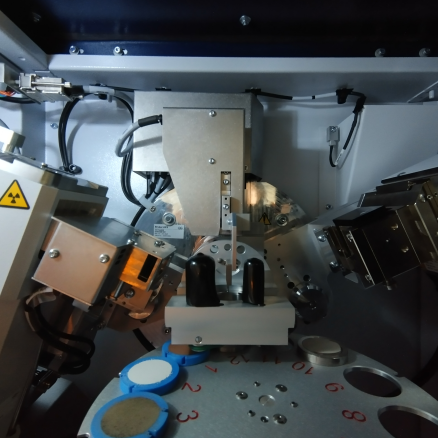
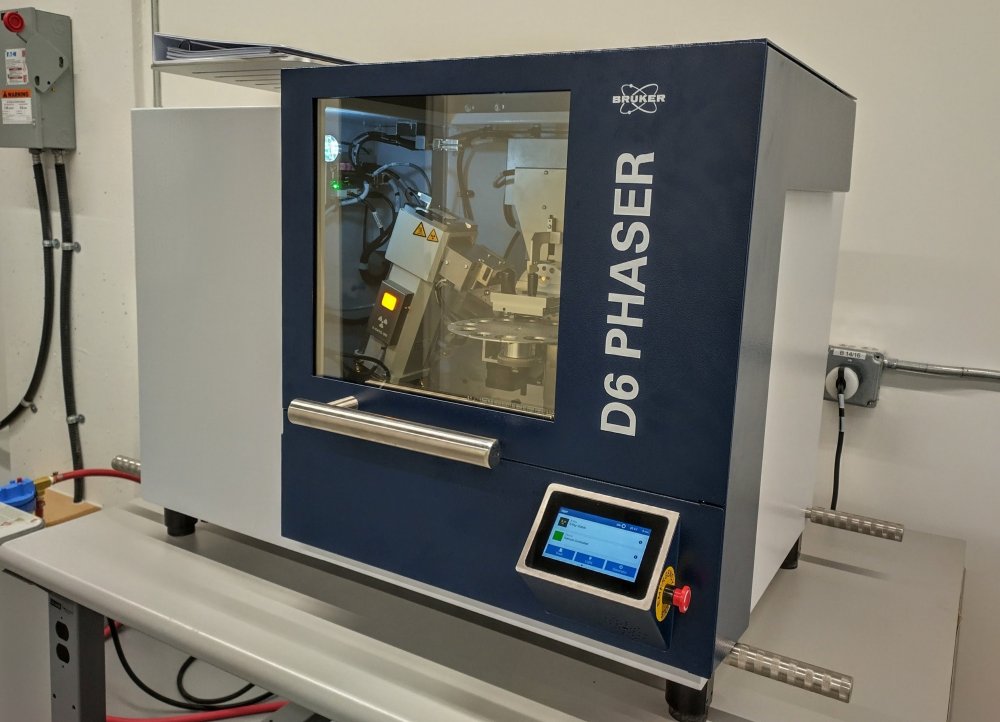 This is Pacific Peak Diffraction’s D6 Phaser x-ray diffractometer (XRD). Our D6 is a Bragg-Brentano
system with a pseudo-theta-theta geometry, a 1200W x-ray generator with Cobalt tube, a full suite of
motorized slits, LynxEye XE-T detector, and a 12 position sample changer. Our XRD is a very potent
package with a rugged, benchtop design and half the footprint of something like a D8 Endeavor or a
D8 Advance. The D6 was a researched, deliberate purchase. Let’s break down what all these
specifications mean and why we chose it.
This is Pacific Peak Diffraction’s D6 Phaser x-ray diffractometer (XRD). Our D6 is a Bragg-Brentano
system with a pseudo-theta-theta geometry, a 1200W x-ray generator with Cobalt tube, a full suite of
motorized slits, LynxEye XE-T detector, and a 12 position sample changer. Our XRD is a very potent
package with a rugged, benchtop design and half the footprint of something like a D8 Endeavor or a
D8 Advance. The D6 was a researched, deliberate purchase. Let’s break down what all these
specifications mean and why we chose it.
Specifications - Our D6 Configuration
| Item | Details | |
|---|---|---|
| X-ray Generator | 1200W, 40kV | |
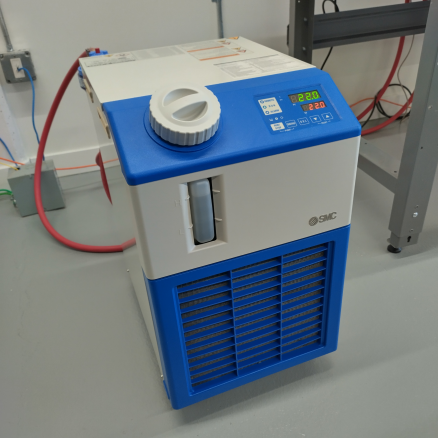
| Cooling | External, SMC HRSF-018-AN-20-T with bypass loop | |
| Tube | Cobalt, Long Fine Focus | |
| Detector | LynxEye XE-T | |
| Slits | Motorized primary divergence slit and anti-scatter screen | |
| Sollers | 4 degree Soller slits | |
| Stage | 12-position sample changer with rotation for 32mm holders | |
A Benchtop XRD? Isn't That a Toy?
First, we would challenge you to lift it. At 160kg, “benchtop” does not imply “portable”. The D6 is in a class of compact systems alongside the Panalytical Aeris and the Rigaku MiniFlex XpC, models that have been released in recent years. These systems are potent, capable instruments, and it can be argued that the D6 Phaser in the 1200W configuration is the most potent XRD among them.
With the benchtop configuration and corresponding small footprint, a lab can squeeze in three of these systems for the price and physical plant of two equivalent full size instruments, with all the added flexibility of having three instruments. This configuration allows for a full duplication of the main instrument for redundancy, added throughput, and/or the ability to add an additional wavelength on a dedicated system.
The goniometer axes are mechanically coupled to a single motor, improving reliability at the cost of flexibility. Our D6 does coupled theta-theta scans. That's fine, it's all we ever expect to do. Having a single motor means fewer opportunities for misalignment or phantom time coordination bugs between motors. We also give up some goniometer radius, which is pretty short at 166.5mm, and not field configurable. Realistically, the goniometer radius is seldom reconfigured in the field.
The 1200W Generator and Cobalt Tube
A 1200W maximum power output seems low when you compare it to the D8 Endeavor at 3000W. Once you consider the tube thermal limits, though, things start to make more sense. The D6 Phaser takes a full-size x-ray tube, so there's no odd supply chain problems.
Because most of our target work is mineralogical, we operate on the Cobalt k-alpha wavelength. Cobalt generally works better than Copper k-alpha for samples containing iron, and expands the pattern at longer lattice spacings. We sacrifice shorter lattice spacing, which is only a problem for structural studies of engineered materials.
Long Fine Focus Cobalt tubes from Bruker have an 1800W thermal maximum power output. Suddenly that 1200W maximum output number isn't quite so small. We can run our D6 Phaser at 2/3rds of the thermal maximum and all it costs is extra sample run time and saves us on tube wear. The capability gap between a D6 and a full size D8 opens up on Copper (2200W thermal limit) or Molybdenum (3000W thermal limit).
Motorized Slits
We've gone all in on constant area irradiation. This means the primary slit changes during the scan to keep the illuminated area on the sample constant. We get more signal at higher angles, less background at lower angles, and the motorized anti-scatter slit over the sample virtually eliminates air scatter. Once you try it, you'll be hooked. No compromises here. Motorized slits are great.
The LynxEye XE-T Detector
The LynxEye XE-T is Bruker's top end strip detector, with 192 channels over an active area of 12x16mm. Having 192 strips doesn't equate to a linear 192x increase in signal over a point detector, but it's pretty close to 100x. These days, a strip detector is a minimum requirement for powder diffraction, and most, if not all, powder systems ship with one.
We went with the LynxEye XE-T detector for the added energy resolution. The LynxEye XE-T has a 350eV-370eV resolution around Cobalt k-alpha (6.93keV). X-ray tubes emit some unwanted x-rays. The only really problematic one for most systems is the higher energy k-beta line. For Cobalt, this line has an energy of 7.65keV. The LynxEye XE-T can suppress almost all of this k-beta signal using pulse height analysis, discarding the unwanted x-rays. Fluorescent signal from the sample is also a problem, and the detector can also suppress most of it with the exception of fluorescence from manganese. Additional fluorescence suppression can be accomplished with a primary Iron filter to remove k-beta before it hits the sample.
Systems without these filtering abilities need monochromators or metal filters to get rid of unwanted x-rays. Having the LynxEye XE-T means we can operate the system with no filters and no monochromator in the beam path. All the signal that those added components would soak up goes right into the detector. All the added complexity from alignment of a monochromator or modelling the absorption edge of the filter goes away.
Higher detector energy resolution gets you better data faster.
Software
For search-match we user Bruker's Eva and the ICDD PDF5+.
For quantitative analysis, we use Bruker's Topas. For a great many reasons, Topas is just better. It's infinitely flexible, extensible, and uses files that can be checked into a version control system or read by custom scripts.
If we had someone else's machine, we'd still be paying Bruker for Topas.
What Did We Give Up?
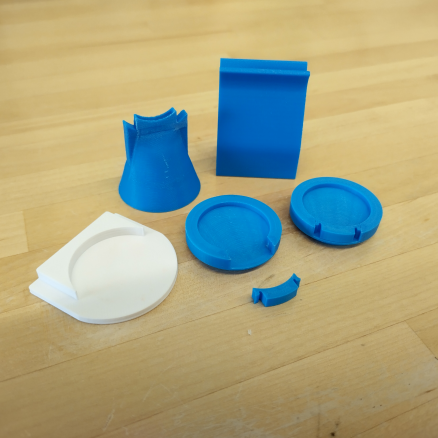
Nothing comes without tradeoffs. To start, it was the move to sample holders compatible with the 12-position sample changer. Bruker's 51.5mm backloading holders are just about perfect. The equivalent product in the 32mm format is far trickier to use. That's why we've moved to custom side-loading holders for less mess and higher throughput. The rest of the 32mm ecosystem is fairly solid, particularly the clay slide holders.
A benchtop machine can't take as many samples as a full size model. The 12 sample auto changer is enough, but will never realistically be able to run 24 hours a day unattended. A D8 Endeavor has more than triple the capacity and a D8 Advance can have more than ten times. There's something to be said for the simplicity of the 12 sample changer, but that 44/60 changer on the Endeavor is tempting.
Lastly, our particular D6 Phaser is a maximalist configuration that barely counts as a benchtop machine. It requires 208V power, and will not run on the usual north american single phase outlet that the lower wattage models will. We also opted for external cooling for increased reliability, which further increases our own infrastructure burden as well as installation complexity. That's why we compare it here to floor models and not competitor benchtop models. It's literally in a class of it's own, as the competitor instruments mostly limit themselves to internal cooling and 120V power for installation simplicity.
Conclusion
The Bruker D6 Phaser is more or less perfect for our current needs. As we ramp up and hit throughput limits, we'll likely expand to an array of similarly configured D6s rather than into larger models.
Having multiple D6 type machines in the future will allow us to standardize on the 32mm holder ecosystem, expand throughput for less money and total physical plant expenditure (floorspace, power), and even diversify into additional wavelengths. The equipment deployment possibilities of multiple D6 systems are an interesting alternative to the equivalent investment in full size instruments.
Additional Images